
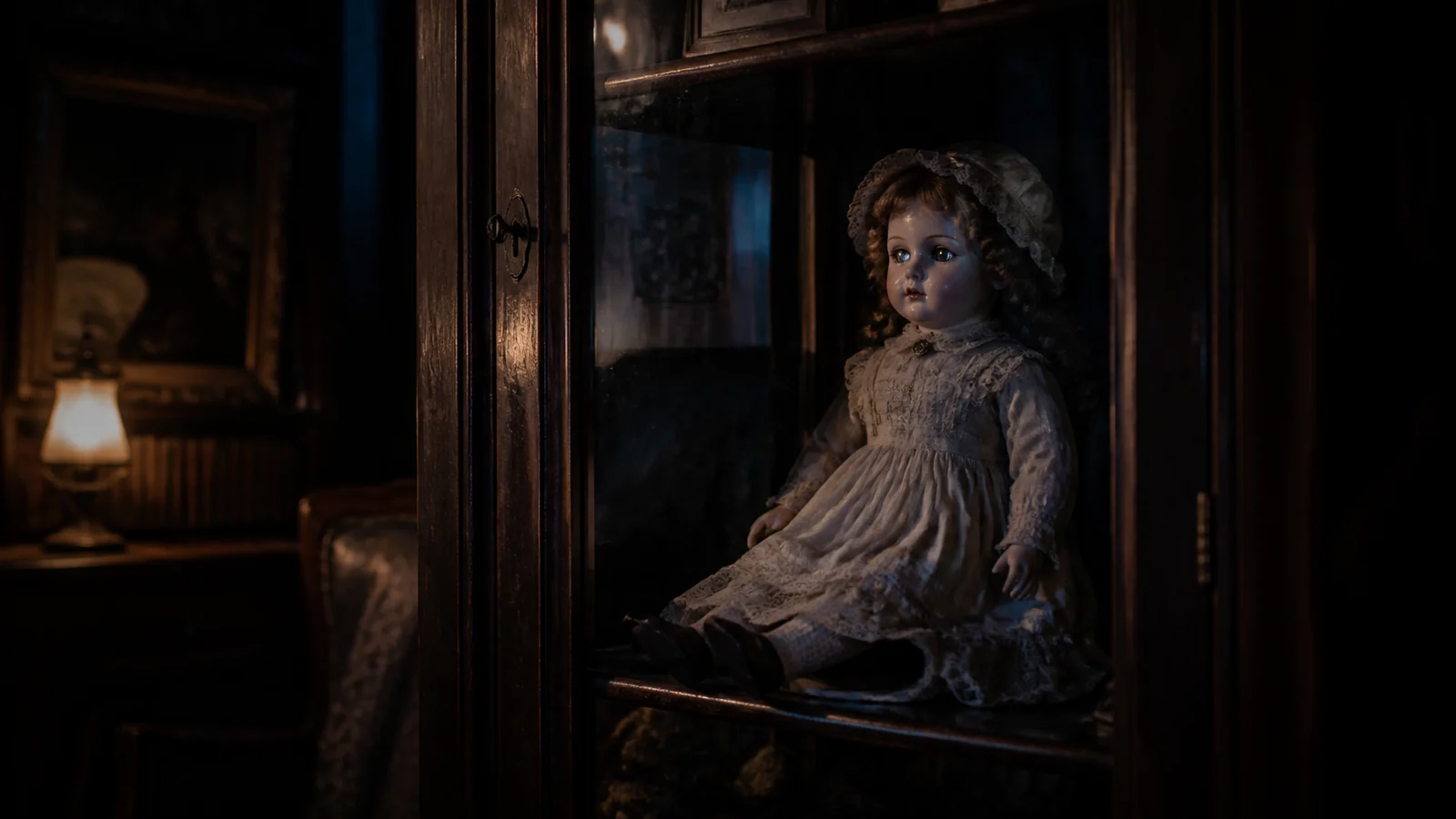
A doll has a face built to be recognized and eyes that cannot recognize you back.
It resembles a person precisely where resemblance matters, then fails every test of life. The mouth keeps one expression. The skin holds one temperature. The gaze never quite meets yours, yet never grants the relief of looking away.
Dolls can feel creepy because they occupy an uncertain boundary between person and object. Humanlike faces attract attention, while fixed expressions, stillness, glassy eyes, and mismatched realism make that familiarity fail. The uncanny valley offers one explanation, especially when lifelike and artificial features conflict, but it is not a universal law that explains every doll or every frightened viewer.
Sometimes the doll looks too human.
Sometimes it is worse because it does not look human enough.
The face arrives before the object
A doll may be cloth, wood, wax, porcelain, vinyl, or plastic. The material changes. The arrangement remains.
Eyes above a nose. A mouth below. A head placed on a body that repeats the human plan.
As discussed in why we see faces in the dark, the visual system gives faces unusual priority. A doll does not merely suggest a face through random marks. It presents one deliberately. The question is not whether the face will be detected. The question is what kind of face the brain believes it has found.
A living face changes continually. Muscles shift around the eyes and mouth. Attention moves. Breathing affects posture. Tiny asymmetries provide evidence of thought and response.
A doll offers the structure without the behavior.
That creates a social signal with nobody behind it.
What is the uncanny valley?
In 1970, Japanese roboticist Masahiro Mori proposed that people may respond more positively as an artificial figure becomes increasingly humanlike—until it becomes almost human. At that point, small imperfections can cause comfort to drop sharply into eeriness. That dip became known as the uncanny valley.
The idea has spread far beyond robotics. It is now applied to computer-generated characters, prosthetic hands, mannequins, wax figures, puppets, masks, and dolls.
The popular version is simple: things that look nearly human are creepy.
The research is less tidy.
Reviews of uncanny-valley studies have found that results depend on how human likeness is manipulated and measured. Some experiments support the effect strongly; others do not reproduce a neat valley. Evidence is particularly useful for perceptual mismatch—features that do not agree about how alive or realistic the figure should appear.
That matters more than the slogan.
A doll with painted features may look comfortably stylized. A highly realistic doll with rigid skin, oversized glass eyes, or an immobile mouth may create conflict. The face asks to be processed as human while individual features refuse to cooperate.
Mismatched realism makes the familiar unfamiliar
Research by Debaleena Chattopadhyay and Karl MacDorman examined what happens when realism becomes inconsistent across a humanlike character. Their work suggests that inconsistency can reduce familiarity and increase cold, eerie feelings in anthropomorphic figures.
Put plainly: the problem may not be realism itself. The problem may be that the eyes belong to one level of reality and the skin to another.
Porcelain dolls provide the classic arrangement. The face may be modeled with soft cheeks and detailed lips, but the surface reflects light like fired material. The eyes may imitate moisture while remaining hard. Painted lashes surround pupils that never contract. Hair looks organic until the edge of the wig becomes visible.
Each feature makes a promise the next feature breaks.
| Doll feature | Human expectation | The mismatch |
|---|---|---|
| Glass eyes | Attention and moisture | Reflection without responsive gaze |
| Fixed smile | Changing emotion | Warmth that continues through every event |
| Jointed body | Purposeful movement | Limbs that move only when acted upon |
| Realistic skin tone | Warm living tissue | Hard, cool, uniform material |
| Human clothing | Social identity | A role without a person performing it |
The result is not simply “almost human.” It is human and object at the same time.

Stillness becomes an unfinished action
A chair is allowed to remain still.
A body is not.
Even a sleeping person offers movement if watched closely enough. The chest rises. Eyes shift under lids. Fingers relax. A doll holds the posture of a body while refusing all involuntary evidence of life.
That stillness becomes more noticeable when the doll is posed as if an action has paused. It sits upright in a chair. It faces the doorway. One arm reaches forward. The head turns slightly more than the torso.
The viewer supplies the missing verb.
It was looking.
It has stopped moving.
It will move when the room is empty.
Horror depends on this expectation. The doll rarely needs to move in front of the audience. It only needs to occupy a different position after attention leaves it.
Showing the man checking the locks works for the same reason. Fear becomes visible through an attempt to establish continuity. A character photographs the shelf before bed. They mark the doll's chair. They close the cabinet. The next scene tests whether the record still agrees with the room.
The object is never where the manifest left it. Join The Grimbard Press and receive Dead Ship, a free illustrated Subscriber Archive Edition.
Why glass eyes feel watchful
Doll eyes do not need to track a viewer to feel intrusive.
Shiny curved surfaces catch highlights. A small point of reflected light makes an eye appear wet and therefore more alive. Because the gaze is fixed, a viewer moving across the room may not receive the normal social evidence that another person's attention has changed.
Some painted or inset eyes also create a familiar portrait effect: the gaze appears directed outward across a range of viewing positions. The doll is not following anyone. Its geometry and the viewer's interpretation produce the impression.
Knowing that can make the object easier to explain without making it pleasant to keep beside the bed.
The problem is not merely that the doll “looks at you.” It is that a face normally reveals where attention is going, and the doll offers no reliable answer.
Old dolls carry other people's stories
A new doll belongs to a store and a manufacturer.
An old doll belongs to everyone who may have held it.
Wear becomes evidence. A rubbed patch on the hand suggests repeated contact. A repaired dress implies care. One missing shoe creates a vanished pair. Cracks in a porcelain face resemble age or injury even though the material is not flesh.
Provenance can be known, partly known, or invented. Horror takes advantage of all three.
An inherited doll arrives with family rules. An antique-shop doll has no witness to contradict the seller. A toy found inside a wall appears to have been deliberately removed from ordinary circulation. The object has survived its owner, and survival begins to look like agency.
This resembles the fear inside changeling folklore: the face is familiar, but recognition no longer settles identity. The ethical history of changeling belief is far more serious than a creepy-toy story, and the traditions should not be flattened together. The shared mechanism is narrower. A familiar form becomes frightening when expected behavior does not arrive.
Horror taught us what dolls are supposed to do
Fiction did not invent discomfort around artificial people, but it gave that discomfort a library.
The haunted doll can contain a spirit. The killer doll can act directly. The prophetic doll announces harm by changing position. The duplicate doll resembles a child too closely. The dollhouse repeats a real building and changes before the building does.
Once those patterns become familiar, an ordinary doll inherits them. The viewer is no longer responding only to porcelain, paint, and glass. They are responding to every story in which those materials became patient.
This is one reason “I have always hated dolls” can feel older than any specific film. The person may not remember the first story that established the rule. The rule remains:
Do not place it where it can see the bed.
Creepiness is not exactly fear
Researchers do not always treat eerie, uncanny, creepy, fearful, and disgusting as interchangeable responses. A figure can feel wrong without producing immediate terror.
Creepiness often involves uncertainty about threat.
A snarling dog announces danger clearly. A doll announces nothing. It has a face, a body, and no visible intention. The observer continues monitoring it because the category remains unresolved.
Is it a harmless object?
Yes.
Why does it need a face?
Because that is what dolls are.
Why is it facing the door?
Someone placed it there.
Who?
The questions do not prove danger. They prevent dismissal.
Why some dolls are charming instead
Not every humanlike object falls into the valley.
Stylization can help. A cloth doll with button eyes does not promise anatomical realism. A cartoon figure establishes its own rules. Familiarity, positive memory, cultural practice, condition, context, and personal experience all shape the response.
The same antique doll may represent family continuity to one person and unbearable scrutiny to another.
That variation is evidence against one grand explanation. Perceptual mismatch matters. So do learning, setting, expectation, and story.
The doll in a bright museum case is an artifact.
The same doll sitting at the top of your stairs at midnight has acquired a scene.
Frequently asked questions
Why are porcelain dolls especially creepy?
Porcelain allows detailed human features while remaining hard, glossy, and immobile. Realistic coloring combined with reflective eyes and an unchanging expression can create a strong mismatch between human appearance and object behavior.
Is the uncanny valley scientifically proven?
Research supports uncanny responses under some conditions, particularly when humanlike features are inconsistent. The effect is context-sensitive, and studies do not support the simplified claim that every increasingly realistic figure produces one predictable valley.
Why do doll eyes seem to follow you?
Fixed outward-facing eyes and curved reflective surfaces can maintain the impression of directed gaze as the viewer moves. The doll is not tracking the viewer, but the face-processing system still interprets the gaze socially.
Is fear of dolls a real phobia?
The term pediophobia is often used for an intense fear of dolls. A blog article cannot diagnose a phobia. Clinically significant fear depends on severity, persistence, distress, and interference with a person's life.
Why do old dolls seem creepier than new ones?
Age adds cracks, stains, wear, repairs, missing history, and evidence of previous owners. Those details invite a story before anything supernatural occurs.
The objects waiting farther inside
There Be Monsters: Among the Dead enters the space where bodies, objects, and presences refuse the categories assigned to them.
Explore the collection or join The Grimbard Press and receive Dead Ship free.
Sources and further reading
- Chattopadhyay and MacDorman, “Familiar Faces Rendered Strange: Why Inconsistent Realism Drives Characters into the Uncanny Valley”, Journal of Vision, 2016.
- Kätsyri et al., “A Review of Empirical Evidence on Different Uncanny Valley Hypotheses”, Frontiers in Psychology, 2015.
- Burleigh et al., “Human Perception of Animacy in Light of the Uncanny Valley Phenomenon”, Perception, 2017.
- Lay et al., “Circling Around the Uncanny Valley”, i-Perception, 2016.