
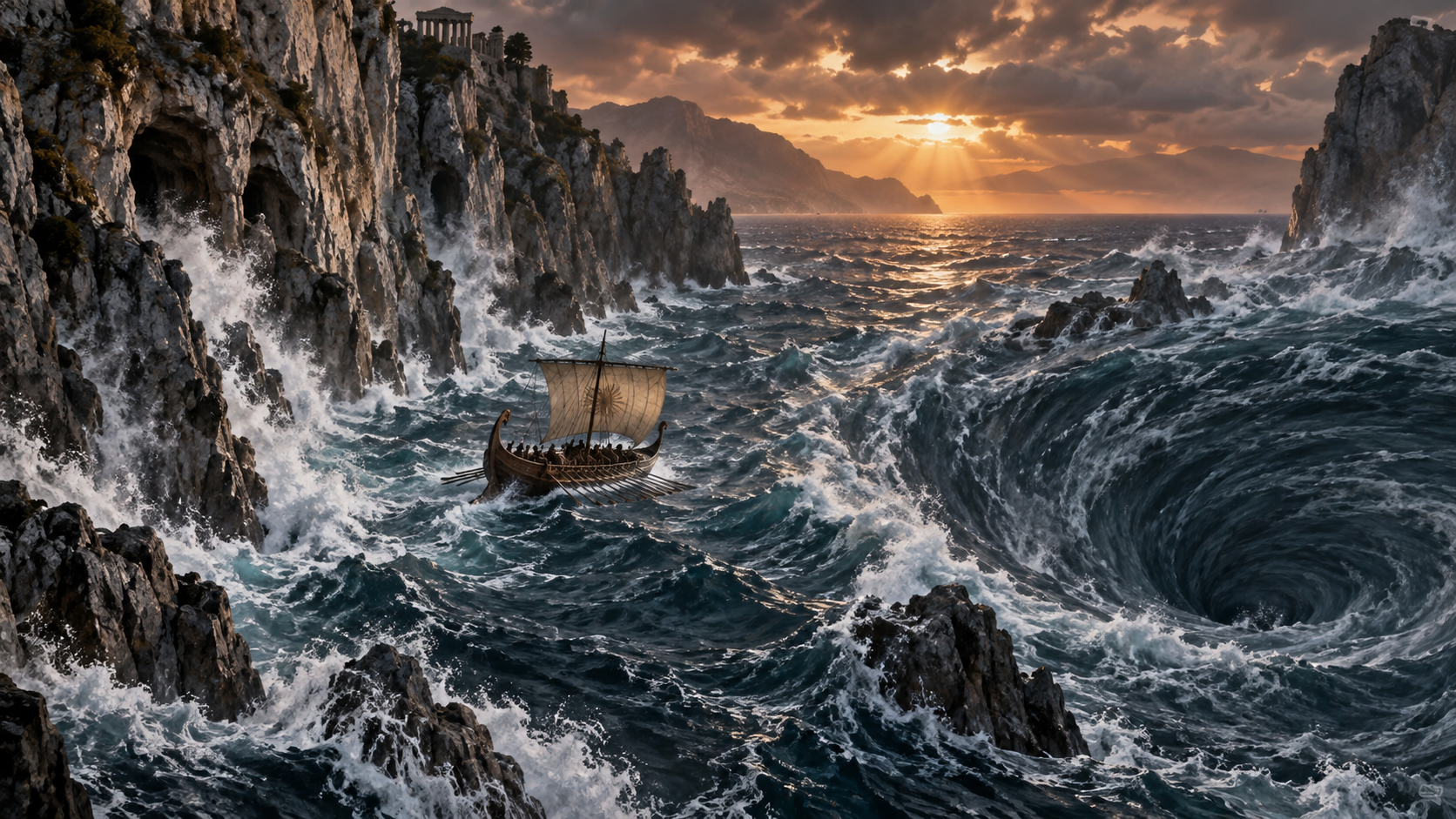
Scylla and Charybdis are the paired sea dangers Odysseus must pass in Book 12 of Homer’s Odyssey. Scylla is a many-headed creature who snatches sailors from a cliff; Charybdis is a destructive whirlpool-like threat on the opposite side. They matter because Homer does not offer a clean victory. Odysseus is told to steer closer to Scylla and lose a few men rather than risk losing the whole ship to Charybdis.
That is why “between Scylla and Charybdis” still means facing two bad options. The phrase is not about indecision. It is about navigating a passage where the sea has made safety impossible.
What Homer actually puts in the strait
In the Odyssey, Book 12, Circe warns Odysseus about the route ahead. Charybdis repeatedly draws in and disgorges the sea; Scylla lives in a cave high above the channel and takes six sailors, one for each head. Homer’s description is not a field guide. It is a piece of mythic geography, built to make the hero choose which terror he can survive.
The details are deliberately uneven. Charybdis is a force of the water—mouth, swallow, surge. Scylla is a predatory body attached to rock and height. One threatens the ship as a whole; the other makes the crew watch individuals disappear. In horror terms, Charybdis is catastrophe. Scylla is selection.
Were Scylla and Charybdis based on a real place?
Later readers commonly connect the pair with the Strait of Messina between Sicily and mainland Italy, a narrow and historically challenging waterway with currents and dangerous coastal geography. That connection is useful context, not a proof that Homer was describing a modern hydrographic chart. Classical scholars continue to discuss the myth’s literary and geographical layers; an Oxford Academic overview treats the pair as part of a long and evolving tradition.
The point is not that sailors saw literal six-headed beasts. The point is that real maritime peril needs a language. A current that can overturn a vessel and a cliff that can take a sailor out of reach are easier to remember when they have appetite, names, and a place in a story.
Why Odysseus chooses Scylla
Circe’s counsel is brutal: sail near Scylla. Odysseus cannot defeat her, and trying to fight may cost everyone. He arms himself anyway, then discovers that courage is not the same as control. Scylla strikes from above and takes six companions before the crew can answer.
The scene is disturbing because it rejects the fantasy that the captain’s strength can save every person. Odysseus makes the better choice and still hears his men calling for him. Homer gives him survival without innocence.
That is the real horror of the passage. A monster fight has rules: strike, flee, outwit. Scylla and Charybdis make the rules structural. The ship must go through. The sea will charge a price. The hero’s task is no longer to win but to decide what loss is survivable.
The two monsters do different work
| Danger | Form in the poem | What it threatens | Horror mechanism | |—|—|—|—| | Scylla | cliff-dwelling, many-headed predator | individual sailors | helpless witnessing | | Charybdis | devouring, surging sea force | the whole ship | mass catastrophe |
This contrast explains their durability. They are not duplicates placed on opposite shores. One is the thing that reaches down; the other is the world opening underneath you. Between them, a crew discovers that a route can be a trap even when it is the only route available.
What the monsters teach about navigation
Ancient seafaring depended on accumulated local knowledge: seasonal weather, recognizable headlands, currents, harbors, and warnings passed from one crew to another. A story can preserve that kind of knowledge without pretending to be a modern manual. “Do not take the middle” or “do not mistake the calm side for the safe side” is memorable when a monster gives the warning a face.
That helps explain why the episode keeps attracting readers outside classical studies. Scylla and Charybdis make geography moral. The passage asks a leader to choose, then denies the comfort of a harmless choice. In a disaster story, the villain may be overcome. In this kind of sea story, the map is the villain. The channel is narrow because the narrative needs the crew close enough to see both terrors at once.
It is also worth resisting the temptation to flatten the myth into a simple proverb. Odysseus is not calmly weighing two abstract options. He is moving through water with exhausted people aboard, after other warnings have already proved deadly. The phrase survived because it describes a recurring human experience, but the poem remains harsher than the phrase: one choice is strategically better and emotionally unbearable.
From maritime warning to monster tradition
Sailors have always given danger a body. In our look at why sailors believed in sea monsters, the sea becomes a place where limited visibility, strange animals, and lives dependent on weather make stories practical as well as frightening. A named terror teaches a lesson: do not trust calm water, do not confuse distance with safety, do not assume the chart has finished explaining the world.
Scylla and Charybdis also show why myth survives adaptation. A modern version can be a storm drain and a collapsing bridge, a corporate rule and an impossible deadline, a ship’s engine failure and a reef. The names endure because the shape of the problem endures: an approaching choice that makes every option feel like a betrayal.
For a historical mystery of a different kind, the Mary Celeste offers another sea story where absence becomes the monster. The facts are stranger when they remain facts.
Where to go after the strait
If you want Greek monsters, maritime dread, and the old stories that taught sailors how little they controlled, Monsters of the Wine-Dark Sea is the natural next read.
Or join The Grimbard Press for Dead Ship, the free illustrated Subscriber Archive Edition.
Frequently asked questions
What are Scylla and Charybdis?
They are paired sea dangers in Homer’s Odyssey. Scylla is a cliffside monster who takes sailors, while Charybdis is a destructive swallowing force in the water opposite her.
Did Odysseus fight Scylla?
He prepares to fight, but he cannot prevent her attack. Circe’s advice is to pass closer to Scylla rather than risk the total destruction associated with Charybdis.
Where were Scylla and Charybdis located?
Later tradition often associates them with the Strait of Messina between Sicily and mainland Italy. That association should be treated as mythic and literary context, not as evidence for literal monsters.
What does “between Scylla and Charybdis” mean?
It means being forced to choose between two dangerous alternatives, especially when avoiding one danger brings you closer to another.
The price of a passage
Scylla and Charybdis last because they refuse a comforting ending. The sea does not reward good intentions. It does not pause for a plan. The ship passes only by accepting that a route can demand something back. That is a monster story with no need for a final blow—just water, stone, and six voices fading behind the stern.
