
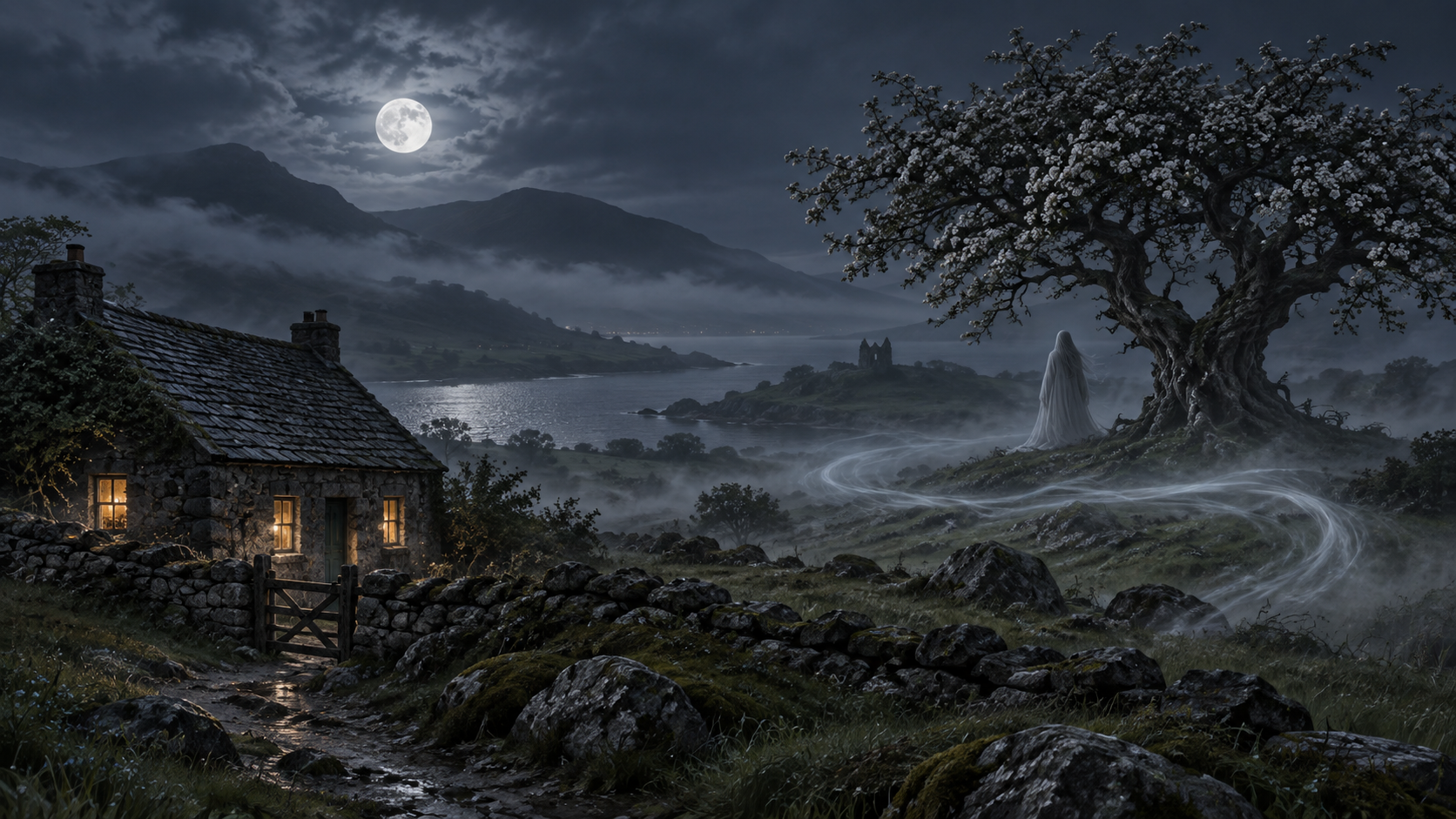
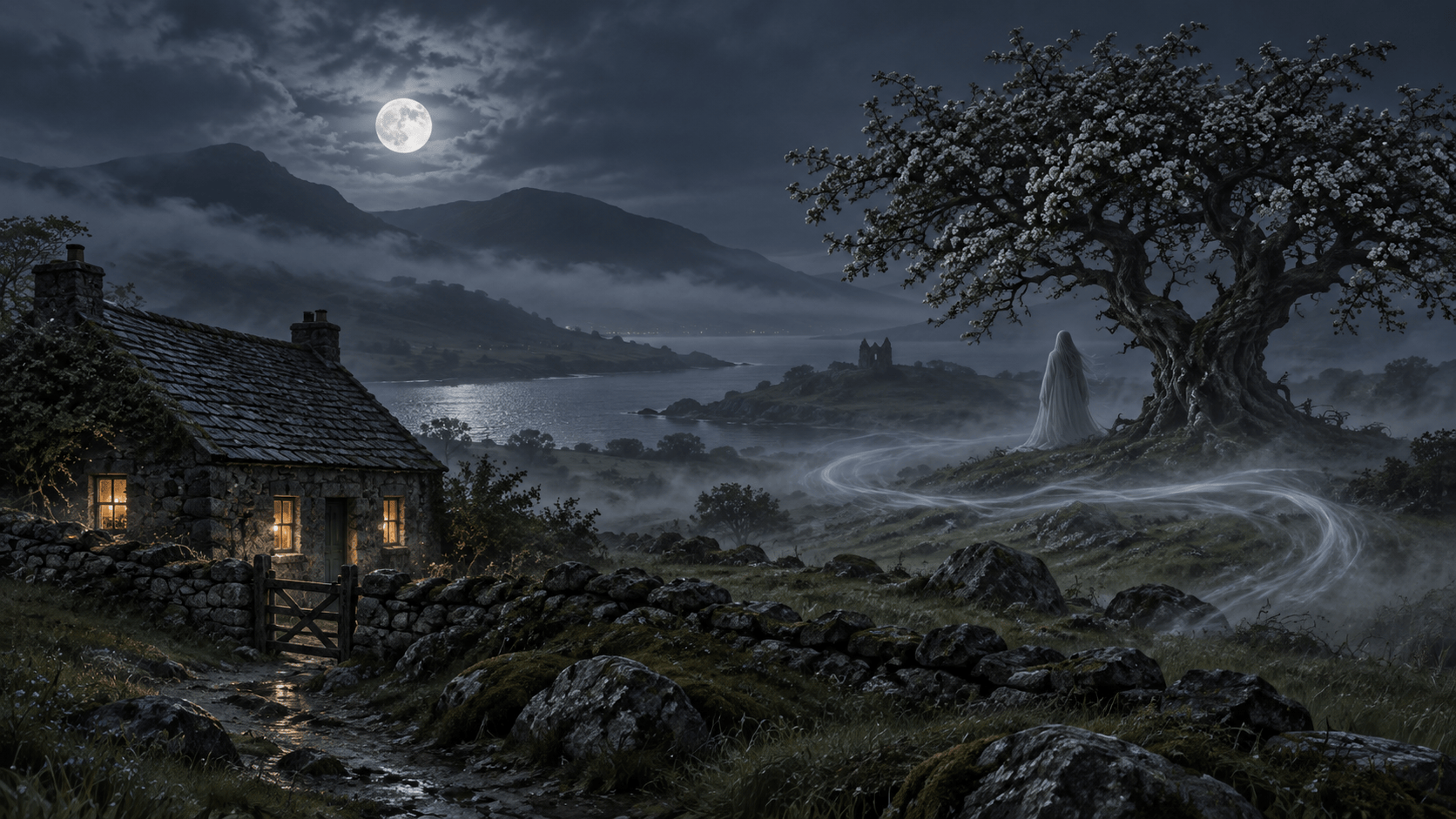
Horror films have made the banshee a screamer: a wailing woman who shows up and shrieks, and then something terrible happens. Irish tradition tells it differently, and the difference is the whole point.
The banshee doesn’t cause a death. She mourns one before it happens.
What “banshee” means
The word comes from the Irish bean sídhe: bean is woman, and sídhe refers to the mounds, the old earthworks and hills where the otherworld was said to live. A woman of the mounds. She isn’t a ghost in the ordinary sense, and she isn’t a demon. She belongs to the older, stranger category of beings that shared the land with people and kept their own rules.
Her one job is to announce a death. She’s heard at night, usually close to the house, sometimes for several nights before. Then someone in the family dies.
The sound is a lament
What people describe hearing isn’t random screaming. It’s keening.
Keening (Irish caoineadh) was the formal lament women performed over the dead at wakes and funerals. It was a skilled practice. Some women were known for it and were asked to keen at wakes. The keen had structure, rising and falling, part song and part speech, calling out the dead person’s name and virtues and the family’s grief. The church spent a long time discouraging it as too pagan and too wild, and by the twentieth century it had mostly faded.
So when people said the banshee was keening, they meant something specific. She was doing for the family what the keening women would do after the death. She was just early.
That makes her something closer to a family retainer than a monster. She grieves with you. She simply knows first.
Whose banshee?
In the older tradition the banshee doesn’t come for just anyone. She attaches to particular families, the old Gaelic lines, the names that begin with Ó or Mac. Some tellings name specific families she was bound to, and there are local traditions all over Ireland about which families had one and what she sounded like.
Families that emigrated said she went with them. There are accounts from America and Australia of Irish families hearing the keen far from home before word of a death arrived by letter weeks later.
What she looks like
Accounts vary, and the variety is part of the legend. She can appear as:
- a young woman with long hair,
- a pale, dignified matron,
- or an old woman, bent and grey, wrapped in a cloak.
Most of the time she’s heard and not seen. When she is seen, she’s often combing her long hair.
Don’t pick up the comb
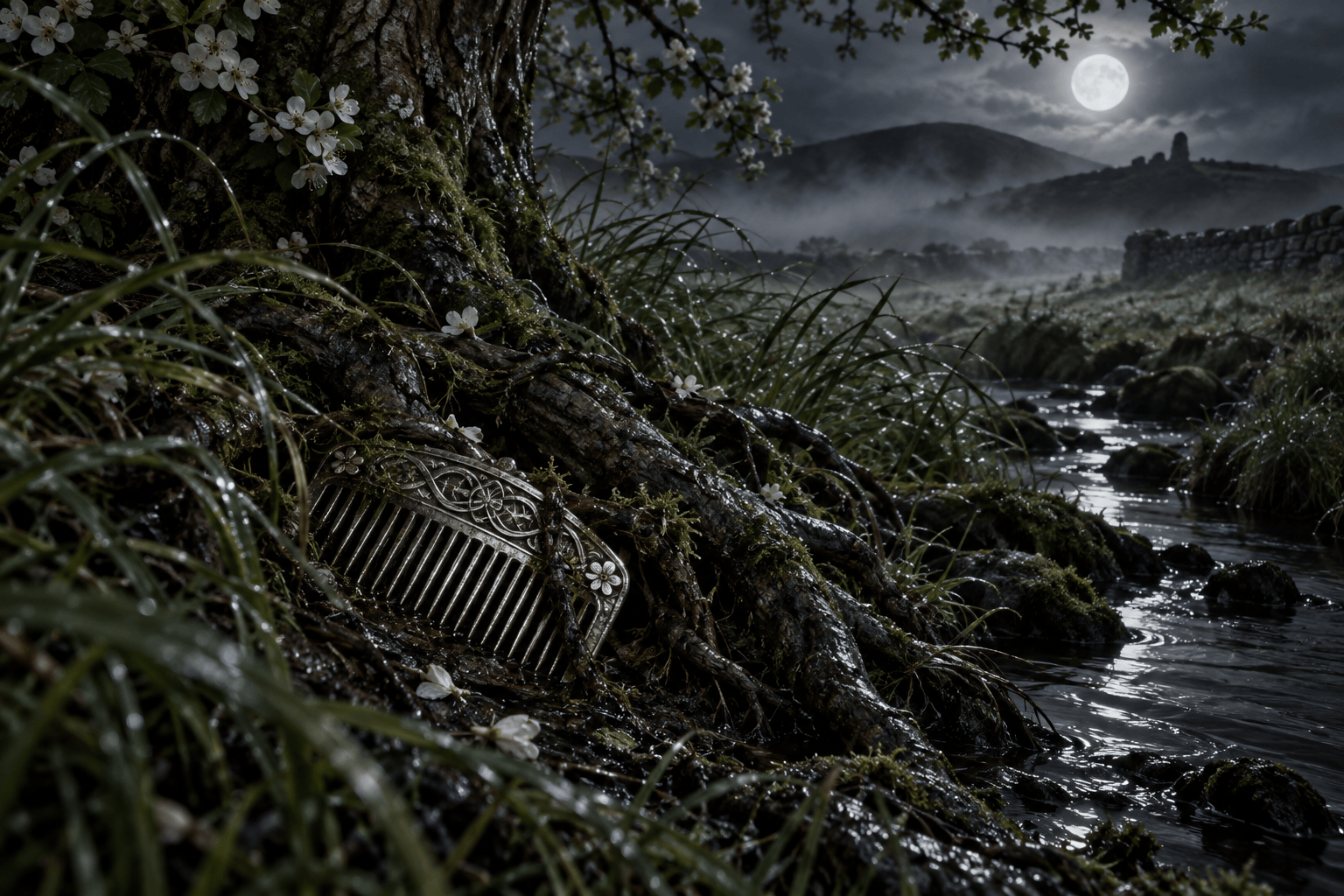
This is the warning that has lasted longest, and you’ll still hear it in parts of Ireland. If you find a comb lying on the road, leave it. It may be hers, and she will come back for it.
What happens to you if you take it depends on who’s telling the story. Some say she comes to the house for it. Some say you lose something you’d miss more. It’s a small rule, the kind that survives because it’s easy to follow: don’t take what isn’t yours from the side of the road on the wrong night.
Her relatives
Scotland has the bean nighe, the washer at the ford: a woman seen at a stream, washing the grave clothes of someone about to die. If you catch her you might get an answer from her, or a wish. Some scholars connect both figures to older war goddesses of Irish myth, the ones who appeared before battles to show who would fall. That connection is debated, but the pattern is clear. The Gaelic world pictured death announced in advance by a woman, and she’s usually doing women’s work around death: washing, mourning, keening.
The other omens in an Irish house
The banshee wasn’t the only warning. Irish and wider British tradition had a whole vocabulary of signs that a death was coming, and many families kept track of several at once:
- Three knocks at the door or on the headboard, with nobody there.
- A bird at the window, or a bird that gets into the house. Robins and magpies especially.
- The death coach, the cóiste bodhar or “silent coach,” a black coach heard on the road at night, sometimes with a headless driver. If it stops at your door, it has come for someone inside.
- The fetch, a double of a living person, seen where that person couldn’t be. Seen in the morning it meant long life. Seen in the evening it meant the opposite.
- A picture falling from the wall for no reason.
And once the death came, there were customs for the house itself. Someone opened a window so the soul could leave. The clocks were stopped at the hour of death. Mirrors were covered or turned to the wall so the soul wouldn’t be caught in the glass on its way out. The body was watched through the night of the wake and never left alone.
Taken together, these customs show a culture that expected death to be announced and treated the days around it as dangerous ground. The banshee is just the most famous of the messengers.
Hearing her in the twentieth century
It’s tempting to treat the banshee as a medieval belief, and it isn’t one. Irish folklore collectors in the twentieth century, including the national Schools’ Collection of the 1930s, recorded banshee accounts from ordinary people describing what their parents and grandparents had heard, often naming the house, the road, and the family. For many rural families she was still a practical fact within living memory. That’s the world “Counting Them Out” is set in: 1948, electric light arriving slowly, and the old women still counting the boats.
Why she’s frightening anyway
She isn’t evil, and she’s still one of the most frightening figures in Irish folklore. The reason is simple: there’s nothing you can do.
Most folklore monsters come with a defense. Salt, iron, running water, a cross cut into a tree. The banshee comes with none, because she isn’t the threat. She’s the news. By the time you hear her, the thing she’s mourning has already been decided.
All you can do is count your family and wait.
The story in October 31
“Counting Them Out” is the third story in October 31.
> October 31st, 1948 — a fishing village, County Clare.
Aoife Nolan is working a splinter out of a neighbor’s palm when the sound comes through the cottage wall. Six boats went out that morning. The old women counted them out, the way they always do. Aoife has never once heard one of them count the boats back in where anyone could hear.
And the keening coming up the harbour road is more voices than there are sons out on the water.
If the legend above is what you believe, you already understand why that last detail matters. What Aoife does with that knowledge is the story.
It’s also the story I’d point you to if you’ve never read anything of mine. It’s short, it’s quiet, and it’s the cleanest read-aloud in the book.
—
Counting Them Out is Night 3 of 31 in October 31, thirty-one folk horror stories set on Halloween night across six centuries. Read it on Amazon → · Free with Kindle Unlimited.
Take the 31 Nights challenge. One story a night through October, with a free printable calendar. Get the calendar →
Previous: Stingy Jack: The Real Irish Origin of the Jack-o’-Lantern · Next: Why Every Story in October 31 Happens on the Same Night