Category: Monster Lore

The mythology, history, and nature of monsters across cultures.

  • Was the Mummy’s Curse Real? How Newspapers Built a Horror Legend

    Was the Mummy’s Curse Real? How Newspapers Built a Horror Legend

    The curse has a perfect first victim.

    George Herbert, the fifth Earl of Carnarvon, helped finance Howard Carter’s search for the tomb of Tutankhamun. The burial chamber was opened in February 1923. Carnarvon died in Cairo that April. A mosquito bite had become infected; blood poisoning followed. The sponsor was dead, the tomb was open, and newspapers had the shape of a story before the excavators had finished clearing the rooms.

    The mummy’s curse was not real in the supernatural sense. No evidence shows that opening Tutankhamun’s tomb caused a chain of deaths, and no inscription in that tomb promised death to everyone who entered. But the legend was not invented from nothing in 1923. Ancient warnings against tomb violation, a century of European mummy entertainment and fiction, colonial anxiety, and sensational reporting were already waiting. Carnarvon’s death made them look like one story.

    The victim came after the plot

    Howard Carter found the first step leading to Tutankhamun’s tomb in November 1922. By the end of that month, he had made a small opening and looked into an antechamber crowded with objects. The formal opening of the burial chamber followed on February 16, 1923.

    Then Carnarvon died.

    The cause was not mysterious. Contemporary and later accounts identify blood poisoning after an infected mosquito bite. The timing, however, was irresistible. A wealthy Englishman had entered the sealed resting place of a king and died within weeks. The facts arrived already arranged like gothic fiction.

    Later lists expanded the curse’s reach. Anyone who visited the tomb, handled an object, knew Carter, or died unexpectedly could be added. Survivors were less interesting. Carter—the man most closely associated with opening and excavating the tomb—lived until 1939.

    That selective accounting matters. A 2002 survival study summarized by HISTORY compared Westerners present for openings or examinations with others connected to the excavation and found no significant association between supposed exposure and survival. National Geographic notes that only six of the 26 people present when the tomb was opened died within the next decade.

    The curse survives by counting the dead and treating the living as irrelevant evidence.

    Mummies were frightening Europeans before Tutankhamun

    The discovery did not teach Europe to fear a mummy’s revenge. It gave an existing story the most famous tomb in the world.

    For centuries, Egyptian human remains had been collected, traded, ground into supposed medicine, publicly unwrapped, displayed, and written into European fantasies. That history is stranger and uglier than the movie version. The mummy did not begin as a bandaged actor walking with both arms extended. It began as a dead person removed from a culture and made into an object.

    Nineteenth-century entertainment helped turn that object into an avenger. Egyptologist Dominic Montserrat traced the popular curse concept to theatrical and literary traditions that predated Carter’s discovery by decades. Louisa May Alcott published “Lost in a Pyramid; or, The Mummy’s Curse” in 1869. Arthur Conan Doyle’s “Lot No. 249,” published in 1892, presented an Oxford student suspected of using a mummy against his enemies.

    Those stories established the machinery: an ancient body is disturbed, an object is removed, and the past reaches into the present to collect a debt.

    By 1922, readers did not need a newspaper to explain how a mummy curse worked. They needed names and dates that made the familiar plot appear to have happened.

    Receive the next recovered file: Join The Grimbard Press for Dead Ship, a free illustrated Subscriber Archive Edition, new monster lore, and book news.

    Ancient warnings were not the modern curse

    There were ancient Egyptian texts that threatened tomb violators. That fact is sometimes presented as proof that the movie curse came directly from pharaonic religion. The connection is not so clean.

    Some tomb inscriptions warned that a person who desecrated the burial or approached in an impure state could face divine judgment or violent death. National Geographic cites Egyptologist Salima Ikram’s description of threats involving gods and dangerous animals. Such language can be understood as protection against robbery and desecration.

    That is not the same as the modern Tutankhamun legend.

    No curse inscription promising death to the excavators was found in Tutankhamun’s tomb. Ancient warnings attached to particular tombs and offenses should not be blended into a universal spell that kills any archaeologist associated with any mummy. The modern version often works like a contagious plot: touch the relic, enter the room, or accept the invitation, and the curse places your name on a list.

    The distinction does not make the ancient warnings unimportant. It reveals what later storytellers changed. A text meant to protect a specific burial becomes the voice of an entire civilization. “Do not rob this tomb” becomes “Egypt punishes those who enter.”

    That transformation tells us more about modern Europe than ancient Egypt.

    The newspapers found a story they already understood

    The excavation was a media event before Carnarvon died. Tutankhamun’s tomb was unusually rich and comparatively intact. Photographs and reports offered readers gold, secrecy, royalty, and a room closed for more than three thousand years.

    The coverage also emerged from a colonial world. British figures controlled much of the international story about an Egyptian king’s burial. Ancient Egyptian lives and bodies had long been treated as material Europeans could possess, interpret, and exhibit. The curse introduced a satisfying reversal: the plundered dead could answer back.

    It answered anxieties that factual excavation reports could not. What if the past was not passive? What if ownership did not erase trespass? What if the dead retained jurisdiction over the room?

    Carnarvon’s death allowed speculation to pass as pattern. Arthur Conan Doyle publicly suggested that an elemental spirit associated with the tomb might have caused it. Newspapers could attach later deaths to the same supernatural cause, even when the connections and timelines differed.

    This does not mean every reporter conspired to fabricate a curse. A legend grows because many people add what the story appears to require. One paper repeats a rumor. Another adds an allegedly ominous inscription. A later retelling removes the word allegedly. Soon the curse seems to have been discovered at the same moment as the tomb.

    The process resembles the press-built “Murder Castle” surrounding H. H. Holmes. A documented crime or death provides the foundation. Reporters, promoters, and later storytellers build the architecture readers remember.

    Coincidence becomes evidence when the list has no edge

    Suppose everyone connected to an excavation is potentially cursed.

    How close must the connection be? Present at the opening? Present in Egypt? A visitor later? A relative? Someone who received an object? If the category can expand after every death, it can never fail.

    This is the curse’s cleverest feature. It is not limited by a stated number of victims or a deadline. A death two months later looks immediate. A death ten years later proves patience. A survivor is merely someone the curse has not reached yet.

    Attempts to replace the supernatural cause with a biological one preserve the shape of the story. Mold and bacteria can exist in enclosed environments, and archaeological work has real occupational hazards. But that does not make a tomb pathogen responsible for Carnarvon’s infected mosquito bite or produce evidence of a fatal Tutankhamun cluster. A scientific-sounding explanation should still be required to explain the actual cases.

    The curse does not win by proving its cause. It wins by making unrelated deaths feel narrated.

    That is the same mechanism examined in the Blood Countess legend. Once a sensational version becomes the organizing story, every detail is asked how it supports the legend. Details that do not cooperate are discarded.

    Why the legend refuses burial

    The mummy’s curse has survived because it solves several emotional problems at once.

    It turns archaeology into trespass. It gives the dead agency. It punishes greed without requiring a court. It converts coincidence into design. It also relieves the audience of deciding how to feel about the removal and display of human remains: the dead make the judgment themselves.

    Most of all, it seals the story.

    A man enters a tomb and dies. Cause and consequence sit close enough that the imagination can lock them together. Blood poisoning is an accident. A curse is an ending.

    The legend has also been visually perfected by a century of fiction. The mummy became a recognizable monster, the scarab became an instrument of menace, and hieroglyphs became shorthand for a warning the characters would ignore. Ancient Egypt was reduced to a room full of traps waiting for Europeans.

    Good modern horror can use that inheritance without repeating its laziness. The tomb is frightening not because an unfamiliar culture is inherently occult. It is frightening because a burial was closed, someone with power opened it, and the dead cannot consent to what happens next.

    What monsters represent in folklore often depends on the boundary they guard. The mummy’s boundary is unmistakable. A sealed door says the living world ends here.

    The curse begins when someone decides the door applies to other people.

    The scarab after the curse

    The mummy’s curse was not real, but it became a real tradition in horror—a machine built from history, appropriation, guilt, wonder, and the fear that possession is not the same thing as permission.

    That machine is still running.

    The Scarab enters the same dark inheritance: an ancient object, a modern hand, and a debt that does not recognize the transfer of ownership. Readers interested in the wider gothic tradition can continue into The Beetle: A Mystery—Annotated.

    Read how The Scarab began, explore the book, or join The Grimbard Press for the next recovered file.

    Sources and further reading

    Continue exploring Grimbard

  • Why Did Sailors Believe in Sea Monsters?

    Why Did Sailors Believe in Sea Monsters?

    First comes the back.

    It rises where no land should be, black and shining through the weather. The sailor sees only part of it before the swell cuts across his view. There is no clean outline, no familiar object beside it for scale. The back seems longer than the boat. Then it rolls, the water erupts, and whatever surfaced is gone.

    By the time the ship reaches port, the glimpse has acquired a head.

    Sailors believed in sea monsters because the ocean gave them real observations without enough context to interpret them. Whales, giant squid, oarfish, unfamiliar carcasses, bad weather, distance, exhaustion, and inherited natural histories all contributed. Old maps then gave uncertain reports visible form. The monsters were not simply lies or decoration; they occupied the moving border between what people had seen and what they thought the sea could contain.

    The sea ruins a good look

    On land, an animal usually appears against something. Trees, buildings, roads, and other animals provide scale. Its feet may be visible. Even when it runs away, the ground explains the direction.

    The sea removes those conveniences.

    Most of an animal remains underwater. Waves interrupt the view. Distance is hard to judge when the background is another moving surface. A body seen from a low wooden deck may appear, vanish, and reappear at a different angle before anyone understands that the pieces belong together.

    Then there is weather. Fog erases the horizon. Storms reduce visibility and force sailors to divide their attention between watching and surviving. A sighting made under those conditions is not worthless, but it is incomplete.

    Incomplete evidence invites the mind to finish the animal.

    One line of humps could be a single long body or several dolphins surfacing in sequence. A whale’s back can suggest an island until it moves. Meanwhile, a floating carcass loses the features that made the living animal recognizable. Even a damaged giant squid does not resemble the streamlined creature that moved through deep water.

    The sailor does not need to be foolish. The observation only needs to be brief.

    Real animals arrived already distorted

    The border between animal and monster was never clean.

    Whales are the clearest example. To someone who knows them from photographs and documentaries, a whale is a known category. To a sailor working before modern zoology, the sudden appearance of an animal longer than the vessel could confirm almost anything written about the ocean.

    European maps and natural histories often depicted whales with tusks, fangs, beastlike heads, or a willingness to attack ships. Smithsonian Ocean’s survey of medieval and Renaissance map monsters notes that even relatively familiar animals could become visually monstrous. The illustrator might never have seen the creature. Instead, a description could pass from sailor to writer to engraver, changing at every hand.

    Likewise, the giant squid followed a similar route from encounter to explanation. A tentacle or damaged body offered proof of an enormous animal without showing how it lived. Oarfish—long, silver, and red-finned—look capable of starting a sea-serpent report even when seen clearly. A decomposed shark or whale can lose its jaw, skin, and familiar proportions until it resembles no cataloged animal at all.

    No one can solve every report from a distance of centuries. Nor should we reduce every sea monster to “probably an oarfish.” The useful point is narrower: real marine life repeatedly supplied shapes stranger than the standard animals people knew on land.

    The ocean did not need to invent monsters. It only needed to reveal an animal one piece at a time.

    The old maps were not failed nautical charts

    One of the easiest mistakes is to imagine a frightened captain steering around an illustrated dragon because it appeared on his navigation map.

    Some decorated maps were not practical charts carried on working ships. They were expensive objects made for display, education, prestige, and wonder. Their sea creatures could fill open water, entertain a wealthy viewer, communicate danger, illustrate religious material, or present what the cartographer believed natural history had established.

    That last purpose matters. According to Smithsonian Ocean, many apparently whimsical creatures came from sources considered authoritative in their time. A cartographer copying a strange marine animal was not necessarily adding fantasy. He could believe he was improving the map’s account of the world.

    Northern creatures crowd Olaus Magnus’s 1539 Carta Marina. Its whales threaten ships. Meanwhile, the “polypus” image and description do not align neatly with one modern species. The map’s sea swine carries moral and religious associations as well as animal features. The map preserves not one kind of knowledge but several layered together: reports, classical inheritance, Christian symbolism, visual drama, and claims about nature.

    That is more interesting than calling the mapmakers gullible.

    They were trying to picture an environment most readers would never see. The blank ocean was not blank to the sailors who crossed it, but their experiences arrived on land as fragments. The monster gave those fragments a body.

    Follow what surfaces next: Join The Grimbard Press for Dead Ship, a free illustrated Subscriber Archive Edition, new monster lore, and recovered files.

    Reports became more certain as they traveled

    A strange sight at sea might begin with honest uncertainty: I saw something large.

    Retelling rewards different details. How large? Larger than the boat. What kind of head? Like a horse, perhaps, or a dog. Did it follow? For a time. Did it attack? It came close enough that the distinction stopped mattering.

    This does not require a deliberate liar. People reconstruct memory, and stories become easier to tell when events have shape. A creature with a name is more portable than a minute of confused water.

    Authority then works backward. Once a respected book or map pictures the monster, a later witness has something with which to identify a new sighting. The image created from earlier reports helps produce the language of the next report.

    The loop is familiar. A witness gives an artist fragments. The artist gives the public a complete creature. The next witness sees the complete creature in the fragments.

    This is also how monsters survive correction. Identifying one carcass does not erase the category. The sea serpent moves to the next wake. The kraken leaves a stranded squid and returns to deeper water.

    What monsters represent in folklore depends partly on where people place them. Sea monsters occupy the largest boundary available: the surface between the human world and a depth no sailor can inspect from the deck.

    Better navigation changed the page

    As European knowledge of marine life expanded and mapmaking conventions changed, monsters became less common on maps. Coastlines improved. Instruments improved. Practical charts focused on the information sailors needed. Natural history and cartography separated into more specialized forms.

    The creatures did not disappear from culture. They moved.

    Sea monsters passed into newspapers, novels, museum displays, film, and cryptozoology. The illustrated map lost its whale with a wolf’s head, but readers gained Moby-Dick, Twenty Thousand Leagues Under the Seas, and generations of cinematic tentacles.

    The modern version often reverses the old one. Earlier cartographers placed a creature on the map as an attempt to show what might inhabit the water. Modern horror starts with a scientific map and asks what it missed.

    That question still has room to work.

    How much of the ocean is actually unexplored?

    The familiar claim that “we have explored only five percent of the ocean” is too blunt to be useful. Exploration, mapping, observation, and biological description are not the same task.

    NOAA Ocean Exploration reported in April 2026 that the entire seafloor has broad satellite-derived coverage, but only 28.7 percent had been mapped to modern high-resolution standards. NOAA also reported that humans and cameras had directly seen less than 0.001 percent of the deep-ocean seafloor.

    Those two figures describe different kinds of knowledge. A high-resolution map can reveal a seamount or wreck. It cannot inventory every animal in the water above it or show how organisms behave across seasons. A remotely operated vehicle can inspect a tiny area directly and still leave the surrounding miles unseen.

    None of this proves that medieval monsters are waiting below. Unknown does not mean anything imagined is equally likely. It means the ocean remains a place where new species, unfamiliar behavior, and unexpected forms are still documented.

    The honest facts are eerie enough. They do not need the old 95-percent line.

    Why the sea monster still works

    A forest monster may be hidden behind the next tree. A sea monster is hidden beneath the surface on which the characters must remain.

    That arrangement gives creature horror a permanent advantage. The boat is a small lit room with no foundation. Water touches every side. As a result, the crew cannot examine the threat without entering the medium in which it is strongest.

    Scale becomes unstable too. A fin offers no proof of the body below. A sound against the hull can be an object, an animal, or the first test. The monster can leave before anyone defeats it and return from any direction.

    Most importantly, the surface conceals action. On land, distance gives warning. At sea, the creature can cross the last hundred feet where no one can see it.

    This is why the best sea monsters are not shown too early. The old sailor’s problem remains the reader’s problem: a real observation without enough context.

    First comes the back.

    Everything else grows below it.

    Sail beyond the margin

    Monsters of the Wine-Dark Sea returns to the oldest waters, where the route home runs through creatures, gods, and the dangerous space between report and belief.

    Readers who want the ancient voyage with its horror brought back to the surface can also enter The Odyssey Annotated: A Horror Reader’s Edition.

    Explore Monsters of the Wine-Dark Sea or join The Grimbard Press for the next dispatch.

    Sources and further reading

  • The Water Keeps Its Dead on a Schedule, and Forensics Can Read the Clock

    The Water Keeps Its Dead on a Schedule, and Forensics Can Read the Clock


    The Slavs believed that a woman who drowned didn’t simply die. She stayed. She became a Rusalka — pale, water-logged, hair heavy and green with algae, living in the river or the pond where she went under, luring the living to the same water that took her. The lore was specific about the timing: she was most dangerous in early summer, when she’d rise from the water and be seen near the banks, and there was a season for her, a window when the drowned came back to the surface of the world.

    Silent dark water and dormant reeds at the edge of a still pond

    I find that last detail remarkable, because it’s true. Not the rising spirit — the schedule. Drowned bodies do come back up, on a timeline, and forensic science can read that timeline with a precision the old villagers would have called sorcery. The Rusalka is folklore’s way of recording a real forensic fact: water processes its dead on a clock, and the clock is legible.


    Casper’s Law, or Why Water Is a Time Machine

    Here’s the foundational rule, and it’s grim in its tidiness. A body decomposes at different rates depending on where it is, and the ratio is remarkably consistent. It’s sometimes called Casper’s Law: a body in open air decomposes roughly twice as fast as one in water, and roughly eight times as fast as one buried in soil. One week of decomposition in air equals about two weeks in water equals about eight weeks underground.

    That single ratio is a tool. A forensic examiner who knows a body was submerged can adjust the entire decomposition clock accordingly. Cold slows it further — cold water is one of the best preservatives nature has, which is why bodies recovered from deep, cold lakes can be startlingly intact months later, and why alpine and northern drownings sometimes surrender the dead looking almost as they did going in. The water didn’t keep her out of respect. It kept her because cold and the exclusion of air are exactly the conditions under which the bacteria of decay work slowest.

    The old lore’s instinct that the drowned are somehow preserved, held, kept present rather than released — that’s not superstition. That’s Casper’s Law, observed without the vocabulary.


    The Refloat: When the River Gives Them Back

    Now the part the Rusalka legend gets eerily right — the rising.

    A drowned body typically sinks. Then, over days to weeks depending on water temperature, the bacteria in the gut and tissues produce gas — the bloating of decomposition. That gas is buoyant. At a certain point the body becomes lighter than the water it displaces, and it refloats, rising to the surface. In warm water this can happen in a few days; in cold water it can take weeks or fail to happen at all until spring warms the depths. Which means there is, genuinely, a season when the drowned return to the surface. Bodies that went under in the cold months can resurface as the water warms in early summer — precisely the season the lore assigned to the Rusalka’s appearance at the banks.

    The villagers watched the drowned come back up when the weather turned, saw them at the water’s edge in early summer, and built a spirit around the pattern. The pattern was thermodynamics. The bloat-and-refloat cycle runs on water temperature, and water temperature runs on the season, and so the dead really do have a calendar. The Rusalka rising in early summer is a folk memory of gas buoyancy and the spring thaw, dressed as a ghost.


    Reading the Clock in the Bones

    When soft tissue is gone, the reading gets harder but doesn’t stop. This is where forensic archaeology takes over from pathology, and where water complicates everything in ways that are themselves informative.

    In water, a specific and useful thing can happen to fat: it converts to adipocere, sometimes called grave wax — a firm, soapy, grayish substance formed when body fat hydrolyzes in a wet, low-oxygen environment. Adipocere is a preservative and a clock. Its presence tells you the body was in wet conditions; the extent of its formation helps bracket how long. A body encased in adipocere can retain its shape and even facial features for decades, which is why remains pulled from bogs and deep water sometimes look impossibly recent.

    The skeleton itself carries datable information. Bone proteins — collagen chief among them — degrade on a timeline, and the degree of that degradation, along with the leaching of minerals in water, helps distinguish remains that are months old from years old from archaeological. Water changes the chemistry of that clock — it can accelerate the loss of certain proteins while the cold slows others — so the forensic archaeologist has to account for the aquatic environment as a variable, not a constant. And there’s the diatom test: microscopic algae with silica shells, present in most natural water, that enter the bloodstream and lodge in the bone marrow only if the person was alive and breathing when they went into the water. Find diatoms in the marrow that match the diatoms in that specific body of water, and you’ve established that the person drowned there, alive, rather than being placed after death. The river signs its own crimes, if you know how to look for the signature.


    Why the Old Lore and the Lab Are the Same Discipline

    Here’s the reframe I keep arriving at when I research this stuff. We think of forensic science and folklore as opposites — one rigorous, one credulous. But they’re doing the same job with different tools. Both are systems for reading the dead. Both look at a body the water has held and try to reconstruct what happened and when. The forensic archaeologist reads adipocere and collagen degradation and diatom counts. The Slavic villager read the season of the resurfacing and the algae in the hair. They reach different explanations, but they’re studying the identical evidence, and the villager’s observations were often empirically sound — the timing, the preservation, the association with specific bodies of water. The metaphysics were wrong. The data collection was not.

    That’s the thing I want people to take from this. The Rusalka isn’t a failure of pre-scientific thinking. It’s a database. It encoded, in a transmissible story, real knowledge about how and when drowned bodies behave — knowledge that kept people cautious around specific waters at specific times of year. The lore was a public-safety record with a face on it, and the face was there so people would remember the data.


    The Contamination Footnote That Should Worry You

    One modern wrinkle the old villagers never faced: polluted water changes the clock. Chemical contamination, altered pH, industrial effluent, and shifting microbial populations in a poisoned waterway can accelerate or distort the normal decomposition timeline, which complicates every forensic estimate built on the assumption of “natural” water. A body recovered from a contaminated river or a runoff-choked pond may not read the way the textbooks predict, because the textbooks assume water that behaves the way water used to. We’ve changed the medium, and in changing it, we’ve smudged the clock that the dead have kept reliably for as long as there’ve been rivers to drown in.

    The Rusalka rose on schedule for a thousand years because the water was, chemically, the same water. It’s not anymore. Somewhere in that fact is a horror story I haven’t finished writing yet — the drowned who no longer come back when they’re supposed to, because we poisoned the machinery that used to return them.


    I write horror that starts in the water and ends in the lab report — the place where the old drowning-spirit turns out to have been keeping accurate records. Get the free story here.

    The fiction this research feeds is There Be Monsters: Then and Now. The rest of the catalog, including the illustrated editions, lives at my Gumroad storefront.

  • Slender Man Was Born in a Photoshop Thread. Then He Got Real.

    Slender Man Was Born in a Photoshop Thread. Then He Got Real.


    We can name the exact moment a monster was born. That has almost never been possible before.

    On June 10, 2009, a user going by “Victor Surge” — real name Eric Knudsen — posted two doctored black-and-white photographs to a Something Awful forum thread. The thread was a contest: take an ordinary photo, edit in something paranormal, make it look like a real found artifact. His entry showed groups of children with a tall, unnaturally thin figure in the background, faceless, in a dark suit, its limbs a little too long. He added fake captions in the clipped voice of an archive note. “One of two recovered photographs from the Stirling City Library blaze.” A librarian’s disappearance. A reference to “the Slender Man.”

    A nostalgic, grainy found photograph of children in a park

    That’s it. That’s the entire origin. A guy won an internet Photoshop contest. Within a decade his invention had its own mythology, a feature film, a video game franchise, and a body count.


    How a Meme Becomes a Folk Belief

    The folklorist Trevor J. Blank has spent years arguing something that sounded strange when he started and sounds obvious now: the internet doesn’t kill folklore, it turbocharges it. Folklore was never about age. It was about transmission — stories that spread person to person, mutating as they go, owned by no one, treated as communal property. That’s exactly what a forum is. That’s exactly what a subreddit is.

    Slender Man is the cleanest case study in existence for how a contemporary legend forms, because we have the whole fossil record. We can watch the mutation happen in real time. Knudsen’s original was sparse — a faceless figure, some missing children, a librarian. Then other users started adding to it, because the forum culture invited them to. Someone gave him tentacles. Someone gave him the ability to induce coughing fits and paranoia in people who researched him too closely, “Slender sickness.” Someone built him a proxy mythology — human servants under his control. Someone made Marble Hornets, a found-footage web series that gave him a coherent visual grammar. None of these people were the author. All of them were the author. That’s precisely how oral folklore always worked; it just used to take three hundred years and a lot of firesides, and now it takes a weekend and a comment section.

    A neural web of glowing connections representing digital transmission

    The thing people get wrong is assuming that “made up on the internet” means “not real folklore.” It’s the opposite. The internet didn’t dilute the folk process. It compressed it. Slender Man went from invention to genuine, sincerely-held-in-some-corners belief faster than any legend in recorded history, and the mechanism was identical to the one that produced every older bogeyman — accretion, anonymity, communal ownership, and the deep human hunger to believe the scary thing is out there.


    The Part Where It Stopped Being Fun

    In 2014, in Waukesha, Wisconsin, two twelve-year-old girls lured a third girl into the woods and stabbed her nineteen times. She survived, barely, by dragging herself to a road. The two attackers told police they did it to become “proxies” of Slender Man — that they believed he was real, that they believed he would kill their families if they didn’t, that they were trying to earn a place in his mansion in the forest.

    This crime should not be used to turn a mental-health crisis into a monster story. The people involved were children, the survivor endured severe violence, and court records included complex mental-health findings. A fictional character did not cause the attack, and no single explanation can responsibly account for it. The lasting lesson is narrower: sensational coverage can turn a real child’s trauma into a mythology about media, belief, and danger.

    That’s the real horror of digital legendry, and it’s got nothing to do with tentacles. A story with no owner, no canonical text, and infinite mutability will eventually be encountered by someone with no filter for where the fiction ends. The old legends had priests, elders, a village context that came bundled with “this is a story we tell, not a thing you do.” The creepypasta has none of that. It arrives context-free, on a screen, presented in the exact documentary style — the fake archive note, the found photograph — designed to erode the line between made-up and found. Knudsen built him to look real. He succeeded past anyone’s intention.


    Why He Works When Older Monsters Don’t

    Set aside the tragedy for a second and ask the craft question: why this figure? A thousand creepypastas were posted that year. Most are forgotten. Slender Man became the first genuinely global native monster of the internet age. Why him?

    Because he’s built out of almost nothing, and the nothing is the point. He has no face — so your brain supplies the worst one it can. He has no stated motive — so he can be about whatever you fear. He appears in the background of photographs of children, in ordinary daylight, at the edge of frame, which is the exact position our peripheral-threat detection is wired to distrust. He doesn’t chase; he’s just there, having been there the whole time, in the photo you’ve already looked at. Knudsen’s original captions did the single smartest thing horror can do: they withheld. No explanation, no origin, no rules. Just a faceless tall thing standing among kids and a note saying the photographer later disappeared.

    Restraint made him. Every attempt since to explain him — the movie especially — has made him smaller, because explanation is the enemy of this kind of dread. The version that scared the world was the version that told you almost nothing and let the folk process, and your own mind, fill the void with something worse than any screenwriter could pitch.


    The Uncomfortable Takeaway

    We are going to keep doing this. Slender Man wasn’t a fluke; he was a proof of concept. The conditions that made him — anonymous authorship, documentary-style fakery, communal mutation, instant global transmission, and an audience that can’t always tell the campfire from the woods — are not going away. They’re intensifying. AI-generated images now do effortlessly what Knudsen did by hand: manufacture found artifacts of things that never existed, in bulk, indistinguishable from the real thing.

    The next Slender Man is already in a thread somewhere, half-built, being passed hand to hand by people who don’t know they’re writing scripture. Most of them will be forgotten. One of them won’t. And the folklorists were right all along: the monsters never needed the old world to survive. They just needed us to keep telling each other, in the dark, that this one might be real.


    I write horror that takes the folk process seriously — including the modern, screen-lit version of it. Get the free story here and I’ll keep sending you the strange from the edge of the frame.

    The fiction this feeds is There Be Monsters: Then and Now. If you want to see where a lot of us first learned that a plain photograph could be the scariest thing in the book, Scary Stories to Tell in the Dark still holds up.

  • The Furies Don’t Forget, and Neither Does Discovery

    The Furies Don’t Forget, and Neither Does Discovery


    The Greeks had a specific, terrible idea about guilt: that it outlives the person who earned it.

    When someone spilled kindred blood — killed a parent, a brother, a guest under their own roof — they didn’t just face the law. They woke the Erinyes. The Furies. Three ancient goddesses older than the Olympian gods, with snakes in their hair and blood weeping from their eyes, who rose from the underworld and pursued the guilty without rest, without mercy, and without any possibility of being outrun. They drove the murderer mad. And here’s the part that matters: they didn’t stop at the murderer. The pollution — miasma — passed down the bloodline. The house of Atreus wasn’t cursed because one man did one bad thing. It was cursed because a crime entered the family and stayed there, working itself out across generations, taking children for the sins of grandparents.

    We tell ourselves we’ve retired this idea. We haven’t. We’ve just incorporated it.


    Miasma Was the First Model of Liability

    Strip the snakes out of the Erinyes and look at the mechanism. A wrong is committed. It is not resolved — not confessed, not paid for, not made right. So it doesn’t dissipate. It becomes a property of the house itself, an outstanding debt attached not to a person but to a lineage, and it collects payment on a schedule no one controls. The Greeks called this divine. I’d call it the most accurate description of institutional consequence ever written.

    Because this is exactly how a buried corporate crime behaves.

    A company does something in 1974 — dumps something, hides a study, signs off on a design it knows will fail. The people who made that decision retire rich and die comfortable. But the decision doesn’t retire. It sits in the groundwater, in the archive, in the settlement that was sealed and forgotten. And then, thirty or forty years later, the miasma surfaces. A cancer cluster. A class action. A journalist with a FOIA request and a grudge. The grandchildren of the original executives — or just the current employees who inherited the company and had nothing to do with the original sin — get pursued by something they can’t outrun and didn’t create. Discovery is the Erinyes with a subpoena. It rises from the underworld of sealed records and it does not forget, because forgetting was never in its nature. Only in ours.

    A dimly lit archive corridor lined with old records

    The Keres and the Actuarial Table

    There’s a lesser-known chthonic figure I think about more than the Furies: the Keres. They were the spirits of violent death — dark, taloned, drinking the blood of the dying on the battlefield. But the useful thing about them is what they represented: not death in general, but the specific, allotted, inescapable death that was coming for a particular person. Your Ker was yours. It was already assigned. Achilles knew his. The horror wasn’t that death existed; it was that yours was a fixed appointment that had been on the books since before you were born, and every step you took was a step toward it.

    That’s fate as a forensic certainty. And it maps with unpleasant precision onto the cold case — the murder that went unsolved for decades, the missing person whose file gathered dust, the death that the institution decided it could afford to leave open. The Keres were the guarantee that the reckoning was coming for someone specific. The cold case unit, working a rape kit that sat untested for twenty-five years, is doing chthonic work: they are the allotted consequence, arriving late but arriving, for a crime that thought it had aged out of jurisdiction. Miasma doesn’t have a statute of limitations. That’s the whole point of miasma.


    Lamia and What Guilt Does to the Guilty

    Then there’s Lamia, who’s usually flattened into a child-eating monster, a bogey to frighten kids. The older version is sadder and more useful. Lamia was a queen — beautiful, and loved by Zeus, which meant hated by Hera. Hera killed Lamia’s children. And Lamia, deranged by grief, became the thing that hunts other people’s children, a mother’s loss curdled into predation. Her deformity wasn’t original. It was acquired. She was made monstrous by what was done to her and then by what the grief did to her from the inside.

    Lamia’s later versions make a useful literary figure for grief that changes a life and then changes the lives around it. Families can carry the effects of violence through memory, relationships, institutions, and material conditions. That is not the same as claiming that a myth explains psychology or that a specific trauma produces an inherited biological destiny. The comparison belongs to literature: a story finding a body for harm that has not been reckoned with.


    Why the Ancestral Curse Is the Right Frame for the Modern Cover-Up

    Here’s my actual position, and a reasonable person can disagree: the individualist story we tell about guilt — that it belongs to the one who did the deed, and dies with him — is a comforting lie, and the Greeks knew it was a lie four thousand years ago.

    Consequence is not individual. It’s institutional and it’s hereditary. The executive who greenlit the defect is protected by time and retirement, but the company is the house, and the house carries the miasma, and the miasma will surface on the underworld’s schedule and take payment from whoever happens to be standing in the lineage when it does. This isn’t mysticism. It’s how negligence, discovery, epigenetics, and cold-case forensics actually operate. The Erinyes were never supernatural. They were the personification of the one fact the guilty most want to deny: that an unresolved wrong is conserved, that it goes underground rather than away, and that it is patient in a way no living person can outlast.

    The murderer in the Greek play always thinks he’s gotten clear. He’s washed his hands, left the city, put years between himself and the deed. And then he hears the wingbeats behind him, and he understands that the distance he ran was never distance at all. It was just the time it took the debt to come due.

    That sound is still behind us. We’ve just renamed it “outstanding liability.”


    I write horror where the buried thing surfaces on its own schedule and the reckoning arrives for whoever’s left holding the house. Get the free story here — the Furies travel light.

    The fiction this research feeds is There Be Monsters: Then and Now. If you want the master class in inherited dread and the slow arrival of consequence, Stephen King’s Cemetery Dance selected fiction is where I’d point you.

  • Lamashtu and Pazuzu: Ancient Demons, Protection, and Fear

    Lamashtu and Pazuzu: Ancient Demons, Protection, and Fear


    Four thousand years ago, a woman in labor in southern Mesopotamia wore a bronze plaque around her neck. On it was a creature with the head of a lion, the teeth of a donkey, taloned feet, and a naked body already sagging with rot. It was suckling a piglet at one breast and a dog at the other. Its name was Lamashtu, and the plaque wasn’t a warning about her. It was a defense against her.

    Lamashtu killed infants. She caused miscarriage, wasting sickness, fever that came in the night and took the child by morning. She poisoned water and touched food and the sick got sicker. To keep her out, you didn’t pray to a kind god. You hung an amulet of a second demon — Pazuzu, king of the wind demons, a thing so foul that even Lamashtu feared him — over the doorway and let the two monsters cancel each other out.

    Ancient bronze plaque with bas-relief carving of the demon Lamashtu

    The comparison to disease is a modern interpretation, not evidence that Mesopotamians had an epidemiological theory in the modern sense. Lamashtu gave frightening pregnancy, childbirth, and infant illness a named antagonist within a religious world. That does not make the belief foolish; it shows how people used ritual, story, and protective objects to face dangers they could not control.


    What Lamashtu Represents

    Lamashtu was blamed for fever, wasting, danger around childbirth, and harm associated with food and water. Those associations do not amount to an ancient medical diagnosis. They show what felt most urgent and frightening in a community’s daily life.

    Southern Mesopotamia was a wetland landscape shaped by reed beds, flooding, domestic animals, and settlements. Modern readers may notice that illness, water, animals, and childbirth can seem connected in such a setting. That resemblance can help us think about environmental uncertainty, but it cannot identify a specific pathogen, transmission pattern, or public-health practice from a demon’s image alone.

    Modern readers may recognize how water, animals, childbirth, and illness can become connected in a wetland society. That resemblance is useful for thinking about environmental risk, but it should not be turned into a retrospective diagnosis of ancient disease. We cannot identify a specific pathogen, transmission pattern, or public-health practice from a demon’s image alone.

    The amulet was a protective religious object, not a quarantine device. Its importance lies in the care it offered within a world of uncertainty: a visible act of defense when danger felt close and consequences could be devastating.


    The Boundary Stone Problem

    Here’s the detail that genuinely unsettles me, and it’s the reason I think the Mesopotamian material is more than a curiosity.

    Kudurru were Babylonian boundary stones associated with land grants and legal claims, often marked with divine symbols and curses against violation. They are not evidence of a biological boundary between settlement and wilderness. Their power here is metaphorical: both a carved stone and a modern containment system make authority visible at a line people are not meant to cross.

    We do exactly the same thing. We call it a biosafety level.

    A BSL-4 laboratory is a boundary stone. It is a line drawn around the most hostile biological material we know of — Ebola, Marburg, the hemorrhagic fevers — with an entire architecture of ritual to keep it inside. Airlocks. Pressure gradients. Suits with their own air supply. Decontamination showers you cannot skip. The whole design philosophy is that on one side of the line is order, and on the other side is a thing that will unmake a human body, and the only thing between them is the integrity of the boundary.

    And the boundaries fail. That’s the part we don’t put on the brochure. Containment breaches happen — a torn glove, a missed step in the decon sequence, an animal that wasn’t as sedated as the record claimed. Every documented lab-acquired infection is a boundary stone that cracked. The Mesopotamians understood, in their bones, that the line was never permanent. That’s why the amulet came off the wall the moment the woman was pregnant again. The threat didn’t retire. It waited at the edge of the settled world for the next lapse in vigilance.

    Abandoned biosafety lab with an empty hazmat suit hanging in containment

    Why This Is Horror and Not Just History

    The engine of the whole thing is that the hostility is ambient. It isn’t a villain with a plan. Lamashtu doesn’t want anything from you. She isn’t testing your faith or punishing your sin. She is simply what the marsh does to a newborn when the marsh is allowed in. She is the outside, personified — and the outside does not negotiate.

    That’s the fear I find most durable, and it’s the one I keep writing toward. Not the monster that hunts you. The monster that is just the nature of the place you happen to be standing. A virus has no motive. It has a mechanism. And a mechanism is so much worse than a motive, because a motive can be reasoned with and a mechanism cannot. You cannot apologize to a filovirus. You cannot bargain with the wet season.

    The people who carved Pazuzu into bronze knew that. They didn’t ask the demon to be merciful. They asked one horror to hold the door against a worse one, and they understood that the door would eventually open anyway.

    We’ve upgraded the amulet to a positive-pressure suit. The door is still the door.


    I write horror where folklore meets the case file: stories that take old fears seriously without pretending a legend is a scientific diagnosis. If that is your kind of dread, get the free story and field notes here.

    The fiction this research feeds lives in There Be Monsters: Then and Now — thirteen monsters, each grounded in a human fear with real historical texture. For the larger question of why cultures make monsters at all, read what monsters represent in folklore. If you want the cosmic-indifference end of this shelf done right, Laird Barron’s The Beautiful Thing That Awaits Us All is where I’d send you next.

  • The Mothman and the Bridge That Fell

    The Mothman and the Bridge That Fell


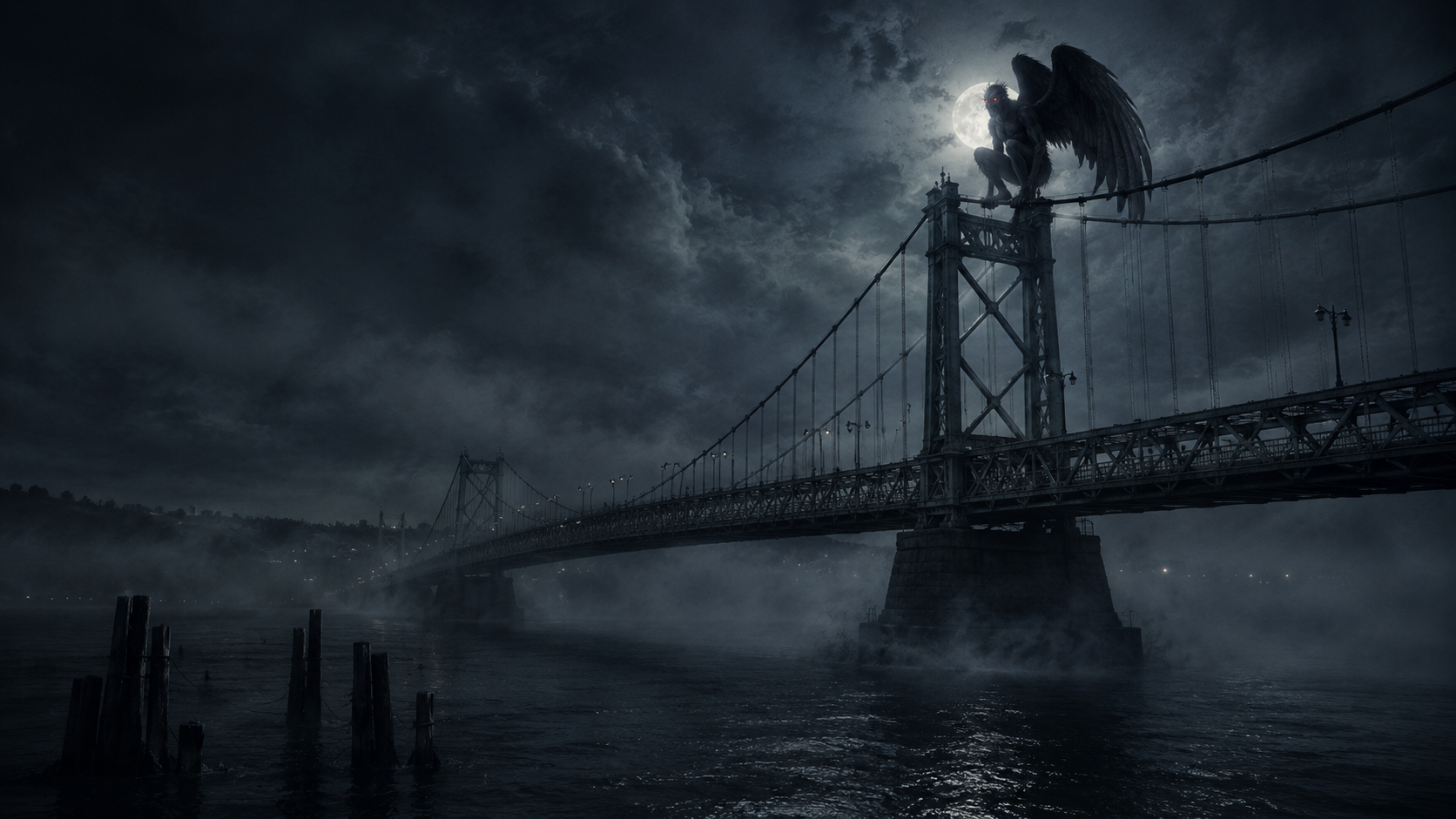
    Forty-six people died when the Silver Bridge collapsed on December 15, 1967.

    It was the evening rush hour in Point Pleasant, West Virginia. The bridge connected the town to Gallipolis, Ohio, across the Ohio River. A single corroded eyebar — one link in a suspension chain — failed first. The rest followed in under a minute. Thirty-one vehicles went into the river. The water was thirty-five feet deep. Many of the dead were still in their cars.

    The disaster was later attributed to a stress fracture in the eyebar that had been present since the bridge was manufactured in 1928. A manufacturing defect. It had been building toward failure for nearly forty years, and no inspection had caught it.

    This is the fact-record version of what happened at Point Pleasant.

    The other version begins thirteen months earlier, in November 1966, when a creature no one had a name for started appearing near the town.


    What People Saw

    The first widely reported sighting came from two couples driving near an abandoned munitions plant known locally as the TNT Area. They described a large humanoid figure, grey or brown, with wings folded against its back and eyes — the eyes are always the detail people lead with — eyes that were large, red, and reflective in headlights. The figure rose from the roadside, spread wings that witnesses estimated at ten to fifteen feet, and followed their car at speeds up to one hundred miles per hour without appearing to beat its wings.

    Over the following year, more than a hundred people in the Point Pleasant area reported seeing something similar. The accounts are not all consistent — some describe a creature closer to seven feet tall, some shorter; some report a distinct chest structure, some don’t. What stays consistent across nearly all accounts: the wings, the red eyes, and the unsettling quality of encountering something that was aware of being watched.

    Local newspaper reporter Mary Hyre documented many of the sightings. She also reported, in the same period, an increase in anomalous phenomena around the town — unusual telephone interference, Men in Black-type encounters, poltergeist activity. John Keel, the journalist and paranormal investigator whose work eventually became The Mothman Prophecies, arrived in 1967 and spent months in the area interviewing witnesses.

    And then the bridge fell, and the sightings stopped.


    The Harbinger Question

    The leap that popular culture made — Mothman as disaster prophet, a creature that appears before catastrophes to warn the unheeding — is more complicated than either believers or skeptics tend to present.

    The factual record is this: the Mothman sightings clustered in a thirteen-month period and ceased after the Silver Bridge collapse. Witnesses who claim to have seen it reported feeling dread, not danger. No one reported the creature pointing at the bridge. No one reported anything that could be interpreted as a specific warning.

    What happened was that the disaster arrived, the sightings stopped, and human pattern recognition did what human pattern recognition does: it connected the preceding anomaly to the tragedy that followed. This is called the clustering illusion and it’s one of the most consistent features of human cognition. We are extremely good at finding patterns and extremely unreliable at distinguishing real patterns from coincidental ones.

    And yet.

    Later retellings connect Mothman-like sightings to disasters far beyond Point Pleasant. Those claims are difficult to verify and should be treated as folklore, not as a documented warning system. The Point Pleasant pattern is the one with the clearest contemporary reporting: unusual sightings first, catastrophe later, and a community trying to make sense of both.

    That distinction matters. A legend can be meaningful without becoming proof. The enduring power of Mothman is not that it predicts disasters, but that it gives a visible shape to dread before anyone knows what the dread is about.


    What the Creature Might Actually Be

    Here’s where I find the Mothman legend genuinely interesting as a piece of cultural history: the biological explanations are more plausible than most people realize, and they don’t actually resolve the problem.

    The most credible naturalistic explanation is that witnesses encountered a Sandhill Crane — a large migratory bird with a wingspan of up to seven feet and eyes that reflect red in low light. This is not a bad explanation. The TNT Area is adjacent to wetlands that cranes use. The height of some witness descriptions matches a crane in flight at unusual angles.

    But it doesn’t explain the hundred-mile-per-hour pursuit. It doesn’t explain the consistent account of red eyes that were described as watching. It doesn’t explain the broader anomalous phenomenon period that Hyre and Keel both documented independently.

    The biological explanation handles the creature. It doesn’t handle the context.

    What I think the Mothman legend is — and this is purely my read — is a community under prolonged stress (Point Pleasant had significant industrial problems, economic decline, and several smaller-scale disasters in the preceding years) generating a meaningful symbol for anxiety it couldn’t otherwise articulate. The creature showed up when things were already wrong. The bridge confirmed what the appearance had suggested.

    Communities do this. They have always done this.

    The Mothman didn’t cause the bridge to fail. But it might have been the shape that the town’s dread took when it needed somewhere to live.


    Point Pleasant Now

    The town of Point Pleasant has fully embraced its most famous inhabitant. There’s a Mothman Museum on Main Street and a twelve-foot stainless steel statue that has become one of the more photographed roadside attractions in West Virginia. The annual Mothman Festival draws tens of thousands of people every September.

    This is not cynicism — I’ve been to roadside attraction towns and I’ve watched communities find dignity and economic purpose in owning their strange history. Point Pleasant does it well.

    The TNT Area is still there. The wetlands are still active. Sandhill cranes still migrate through.

    If you go in November, and you’re driving the back roads after dark, and something large rises from the roadside ahead of you and holds your headlights in its eyes —

    Well. You’ll know to pay attention to the bridges.


    Creature features, folklore deep dives, and the horror that lives in specific places — join the Grimbard list.

    If you want to read the fiction this research feeds: There Be Monsters: Then and Now


    What is established—and what remains folklore?

    • Established: the Silver Bridge collapsed on December 15, 1967, killing 46 people; investigators traced the failure to a defective eyebar.
    • Documented local legend: Point Pleasant residents and local reporter Mary Hyre recorded Mothman sightings during the preceding thirteen months.
    • Unresolved: what witnesses saw, and whether the sightings had any connection to the collapse. Neither the creature nor a predictive link is established by the historical record.

    For the larger question of why communities turn a frightening place into a story, read what makes folk horror different. For another creature legend handled with the same evidence-first approach, explore the Monster Lore archive.

  • The Skinwalker: What the Navajo Legend Actually Warns Us About

    The Skinwalker: What the Navajo Legend Actually Warns Us About


    The version of the Skinwalker that lives on Reddit is a bipedal thing that chases cars on desert highways. A speed demon. Something you catch at the edge of your headlights doing something no human body should be able to do — running alongside you at seventy miles an hour, or crouched where it shouldn’t fit, or looking at you from the wrong direction in your mirror.

    That version is terrifying. It’s also about forty percent of the actual tradition, stripped of the part that makes it genuinely disturbing.

    The Skinwalker — yee naaldlooshii in Diné bizaad, which translates roughly as “by means of it, it goes on all fours” — is not primarily a speed story or a pursuit story. It is a transformation story. And the thing it transforms is the most frightening part of all.


    What Gets Made

    A yee naaldlooshii is a human being who has chosen to become something else.

    Not cursed. Not bitten. Not inherited. Chosen.

    In the Navajo tradition, a Skinwalker is a practitioner of ‘ánt’įįhnii — what outsiders translate as witchcraft — who has completed a specific, deliberate act of corruption. The nature of that act varies in specificity across accounts, but the consistent element is this: it involves the killing of a close family member. A sibling. A parent. A child.

    The Skinwalker does not become evil through supernatural contamination. The evil act is the threshold. You have to cross it yourself.

    This is what separates the yee naaldlooshii from almost every other monster in Western horror tradition. A werewolf is often a victim. A vampire was transformed by violence done to them. Even the ghost typically died in circumstances they didn’t choose. The Skinwalker chose — and what they received in exchange is not just speed or shapeshifting, but the removal of the constraint that had held them inside a human moral framework.

    The power is real. But the cost is your self.


    The Skin and What It Means

    The “skin” in Skinwalker is literal. The practitioner wears the pelt of an animal — typically coyote, wolf, fox, owl, or crow — to take on that creature’s form. This is where the highway encounters come from; a person wearing a wolf skin running faster than a vehicle, or a figure crouched impossibly in the road, is the physical expression of a human inside an animal body.

    But the specific animals matter. Every one of them carries weight in Navajo cosmology. Coyote is the trickster, the boundary-violator, the one who appears at the margins of order. Wolf is dangerous power. The owl — same as with the Wendigo tradition — carries the dead. These aren’t random choices. The practitioner isn’t just putting on a disguise; they’re wearing a relationship to the world.

    The closest thing in Western tradition might be the berserker — a Norse warrior who wore a bearskin and was said to fight in a state beyond human reckoning. But the berserker transformation was temporary. The yee naaldlooshii does not have an off switch. The boundary between the practitioner and the animal gets thinner with use. Eventually, some accounts suggest, there’s nothing left that remembers being human.


    The Skinwalker Ranch Problem

    In 1996, a Utah ranch became famous — notorious — as a hotspot for Skinwalker activity. Livestock mutilations. UFO sightings. Poltergeist phenomena. A series of books, a documentary, and eventually a cable television series followed.

    Here’s the problem: Skinwalker Ranch is in the Uintah Basin of northeastern Utah. The land is associated with the Ute people, not the Navajo. The Skinwalker is a specifically Navajo tradition. The two are not the same.

    The conflation is not harmless. When a piece of indigenous knowledge gets detached from its cultural origin and reapplied to a piece of land it has no historical connection to, what you get is not expanded understanding — you get a brand. The terror tourism around Skinwalker Ranch has generated considerable money. The Navajo Nation has generated approximately none of it. And the tradition gets used in ways that erase the context that makes it meaningful.

    I’m not saying the Uintah Basin doesn’t have strange history. It might. But whatever is happening there is probably better understood through Ute cosmology, if through any indigenous lens at all.

    The Skinwalker has been adopted by horror culture in ways that the community it came from has, repeatedly and explicitly, asked people to stop. When you see that pattern — a specific ask from a living culture to stop appropriating their spiritual tradition as entertainment — it’s worth pausing to ask what you actually gain by ignoring it.


    Why the Warning Still Matters

    Strip the cultural mechanics away entirely and the core of the Skinwalker legend is this: power is available to people who are willing to do the thing that cannot be undone. And the transformation that follows isn’t just physical. You don’t just get fast. You get outside the community that would hold you accountable. You become something that moves at the margins, that cannot come back into the firelight, that must keep moving because stopping means being seen for what you are.

    Every community has people who chose that trade.

    The Navajo had a name for them. That’s not superstition. That’s observation, compressed into a form that survives.


    Horror draws on traditions like this one because they’ve already done the work — they’ve looked at the dark thing directly and named it. I try to do the same in my fiction. If you want to see what that looks like, There Be Monsters: Then and Now is a good place to start.

    Want more folklore, creature features, and the kind of horror that came from somewhere real? Join the Grimbard list.