

Salem gets the attention. The trials of 1692 produced the most executions, the most records, and eventually the most films, so they’ve come to stand in for the whole history of witchcraft in New England.
But Salem was not the beginning. By the time the girls in Salem Village started having fits, Massachusetts Bay and its neighbors had been hanging accused witches for more than forty years. The ideas that drove those earlier cases came over on the same ships as the colonists, and one of the most important ideas was the familiar.
The first executions
The first person known to have been executed for witchcraft in the English colonies was Alse Young, hanged at Hartford in the Connecticut Colony in 1647. Almost nothing of her case survives except the fact of it.
A year later Massachusetts Bay had its own. Margaret Jones of Charlestown was a healer and midwife, which was dangerous work in a century that couldn’t always tell a remedy from a spell. She was accused of having a “malignant touch,” meaning people she handled grew sick. Her remedies were said to work too well, or too strangely. Her body was searched for the marks thought to show a witch, and a witness claimed to have seen a small child run from her that then vanished, which the court read as an imp. She was hanged in Boston in June 1648. Governor John Winthrop recorded the case in his journal and noted, with some satisfaction, that a great storm struck Connecticut at the hour of her execution.
In 1656 Boston hanged Ann Hibbins, the widow of a well-off merchant. She was sharp-tongued and quarrelsome, had been excommunicated from her church years earlier, and after her husband’s death had few friends left. A jury convicted her. The magistrates refused to accept the verdict, so the case went to the General Court, which convicted her again. Nathaniel Hawthorne later put her in The Scarlet Letter as Mistress Hibbins, the governor’s sister who keeps inviting Hester into the forest.
These cases, and others in Springfield, Connecticut, and elsewhere through the 1650s and 1660s, are the colonial prologue to Salem. They are smaller, less documented, and in some ways more frightening for it. One neighbor’s word, one sick child, one marked body, and a single life ends in front of the whole village.
The law of the familiar

To understand these cases you need the English law they grew out of.
The Witchcraft Act of 1604, passed under James I, made it a felony to consult, covenant with, entertain, employ, feed or reward any evil and wicked spirit. It’s an odd list to find in a statute, and it tells you what the authorities were afraid of: not just spells, but relationships. A witch was someone who kept company with a spirit and paid it.
That spirit was the familiar. English witch belief, more than the continental version, fixed on the idea that a witch kept a small demon in animal form, which she fed, sometimes from her own body. The “witch’s mark” that searchers looked for on suspects was supposed to be the place where the familiar suckled.
The belief peaked in England in the 1640s, when Matthew Hopkins, the self-styled Witchfinder General, and his associates worked through East Anglia. Their methods included “watching”: keeping a suspect awake and under observation for days, waiting for her familiar to come to her. Suspects, exhausted, sometimes named their familiars. Records from those trials list cats, dogs, toads, mice, polecats, and creatures with no name at all.
The colonists of Massachusetts Bay were English Puritans, many from exactly those eastern counties. They didn’t leave the familiar behind.
How an accusation became a hanging
It helps to picture how a case like Margaret Jones’s actually moved, because the process was more ordinary, and more frightening, than the films suggest.
It usually began with a misfortune and a neighbor. A child sickened, a cow died, butter wouldn’t come in the churn, and someone remembered a quarrel. Complaints could collect over years before anyone went to a magistrate. When someone did, the accused was examined, questioned by magistrates who already suspected her, often in front of her accusers.
Then came the search. A group of women examined the accused’s body for a mark: an unusual spot, growth, or teat that could be read as the place her familiar fed. Nearly every older body had something that could qualify.
Evidence was collected from neighbors: what she had said in anger, who had fallen ill after she visited, what animals had been seen near her house. A small creature seen running from her door, as in the Jones case, was exactly the kind of testimony that mattered, because it pointed to a familiar.
The case then went before a jury and the colony’s court. In Massachusetts Bay, witchcraft was a capital crime under the colony’s own laws, which cited scripture directly: Thou shalt not suffer a witch to live. Conviction was not automatic, and some accused people were acquitted or had verdicts overturned. But when the court did convict, the sentence was death by hanging, carried out in public.
What made the earlier cases different from Salem was scale. They were usually one accused person at a time, in a small community where everyone knew everyone. Nobody needed a panic. A long memory was enough.
Familiars beyond the courtroom
Belief in familiars didn’t end with the trials. Through the eighteenth and nineteenth centuries, English and American folklore kept the idea alive in quieter forms: the cunning woman’s cat, the toad kept in a box, the black dog met on the road. Some of the rural healers who were accused in the 1600s had descendants in the 1800s who were still consulted for charms and cures, and still, sometimes, suspected.
The cat is the version that survived into Halloween decorations. The history behind it is the history above.
Why the cat
The black cat’s reputation as a witch’s companion is a mix of older European suspicion of cats, the familiar trials, and the simple fact that an old woman living alone was likely to keep one. In the trial records the familiar could be almost any animal. In the popular imagination it became the cat.
The cat also had a reputation for surviving. The saying that a cat has nine lives was already an English proverb by the mid-1500s. An animal that kept coming back, that watched and never seemed to age, was an animal people didn’t trust.
The story in October 31
“Nine Lives, All Spent” is the fifth story in October 31.
> October 31st, 1653 — a village, Massachusetts Bay Colony.
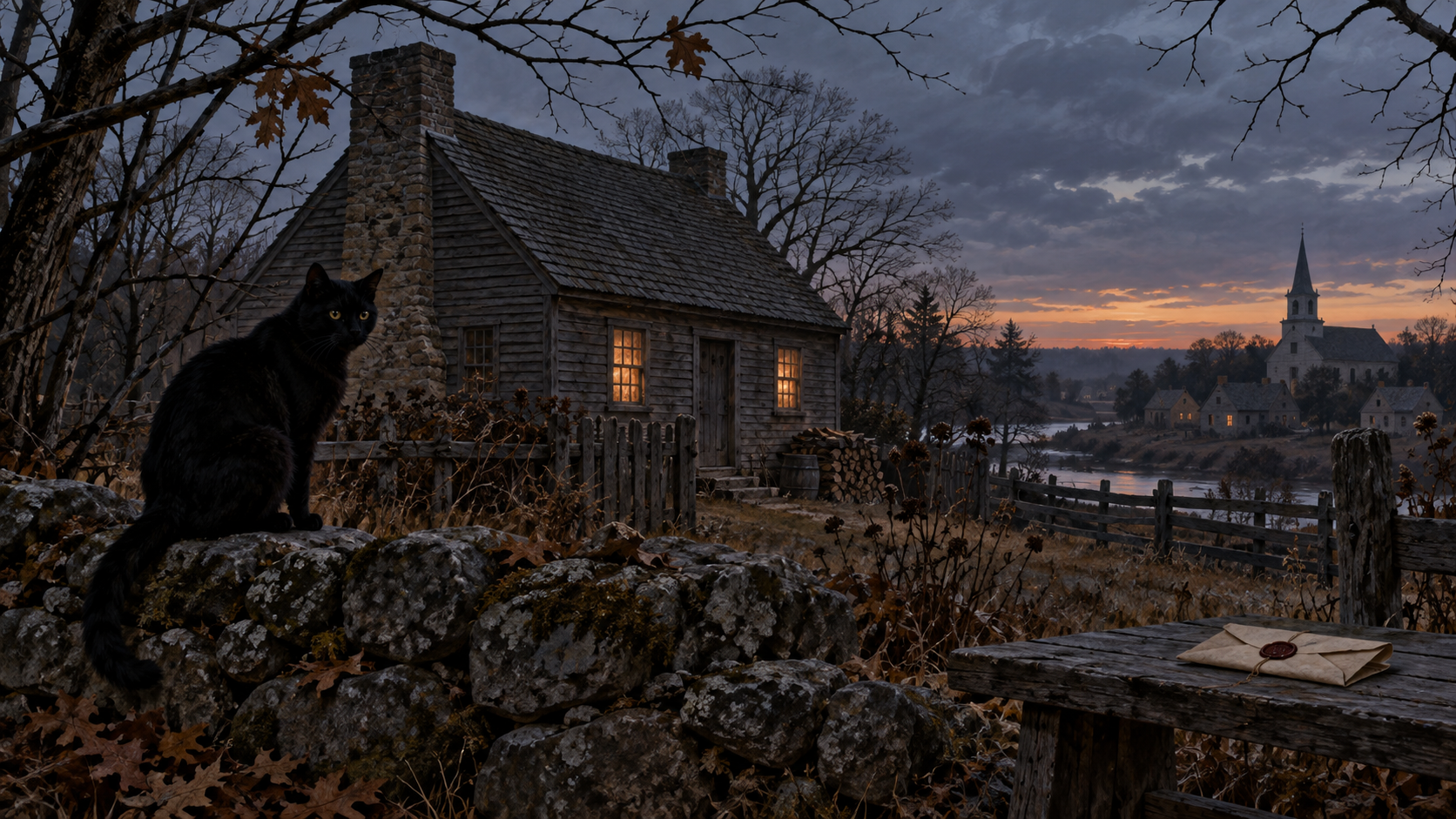
Temperance Ashcombe milked the goat that morning, the same as any morning. The goat knew nothing of hangings. It knew only that for eleven mornings the girl had done the tending, because the old woman who usually did it had been taken away.
Then the meetinghouse bell starts. It isn’t the Sabbath ring, and it isn’t fire. One flat iron note, then the space for the whole village to hear it, then another. Come out. Come see a thing done.
The cat is waiting on the doorstone. It has been old for as long as Temperance can remember, and it has never behaved old a day in its life. It’s black from nose to tail except for three white hairs under the chin, which her grandmother used to say proved God had nearly changed His mind.
The village and the trial are fiction. The fear is taken from the record above.
A note on the real dead
It’s easy to turn this history into set dressing. The people hanged in Hartford and Boston were real, and nearly every one of them was a woman who was old, poor, argumentative, alone, or skilled at something her neighbors didn’t understand. In 2023 Connecticut formally exonerated the people it convicted of witchcraft in the 1600s. Work to clear the remaining names in Massachusetts has continued since.
The story takes the folklore seriously. It takes the history more seriously still.
—
Nine Lives, All Spent is Night 5 of 31 in October 31, thirty-one folk horror stories set on Halloween night across six centuries. Read it on Amazon → · Free with Kindle Unlimited.
Take the 31 Nights challenge. One story a night through October, with a free printable calendar. Get the calendar →
Previous: Why Every Story in October 31 Happens on the Same Night · Next: The 1996 Chupacabra Panic: What Happened in South Texas